
Why Platts and ICIS Price Revisions Are Critical to the Polymer Market
Summary
In the global polymer market, price revisions by Price Reporting Agencies (PRAs) like ICIS and S&P Global Platts serve as definitive benchmarks for spot trading, contract indexing, and risk management. Their neutral daily and weekly price assessments bring transparency to raw material pricing, allowing buyers, suppliers, and procurement leaders to navigate feedstock volatility, Incoterm adjustments, and supply-demand shifts confidently.

In the highly volatile global polymer market—covering essential resins like Polyethylene (HDPE, LLDPE, LDPE), Polypropylene (PP), and Polyvinyl Chloride (PVC)—prices fluctuate daily based on crude oil shifts, naphtha feedstocks, regional demand, and freight disruptions.
For procurement managers, resin converters, traders, and petrochemical manufacturers, tracking independent Price Reporting Agencies (PRAs) like ICIS and S&P Global Platts is not optional; it is fundamental to business operations.
Here is a deep dive into why Platts and ICIS price revisions carry immense weight in the polymer ecosystem.
1. Global Benchmark for Contract Indexing & Formulas
The majority of medium-to-long-term polymer supply contracts are directly indexed to ICIS or Platts publications rather than fixed prices.
- Formula Pricing: B2B contracts typically state that the final invoice price per metric ton will be equal to the ICIS/Platts Midpoint Assessment +/- a negotiated margin.
- Automatic Market Adjustment: When an ICIS or Platts price revision is published, thousands of supply contracts adjust automatically across global supply chains without needing renegotiation.
2. Neutral Transparency in an Unregulated Market
Unlike stocks or commodities traded on public exchanges (like gold or crude oil futures), polymers are primarily traded over-the-counter (OTC). There is no single centralised exchange setting a uniform global price.
- Methodology-Driven Insights: Platts and ICIS survey hundreds of active market transactions, bids, offers, and regional supply balances.
- Independent Authority: By evaluating verified market deals on standard Incoterms (e.g., FOB Houston, CFR China, FD West Europe), PRAs provide an objective price range (Low-High) and midpoint that both buyers and sellers trust.
3. Spot Market Leadership and Forward Indicators
In turning markets, spot price revisions reported by Platts and ICIS act as early warning indicators for contract pricing movements.
- Upstream Feedstock Linkages: When upstream monomer costs (Ethylene, Propylene) shift due to cracker outages or crude oil swings, spot polymer assessments capture this volatility immediately.
- Inventory & Procurement Timing: A downward or upward revision signals whether procurement teams should aggressively build resin inventory or delay spot purchases to capture lower pricing in upcoming cycles.
4. Supply Chain & Incoterm Standardisation
Polymer trade involves complex international shipping terms. A key reason Platts and ICIS revisions are indispensable is their exact breakdown of delivery parameters:
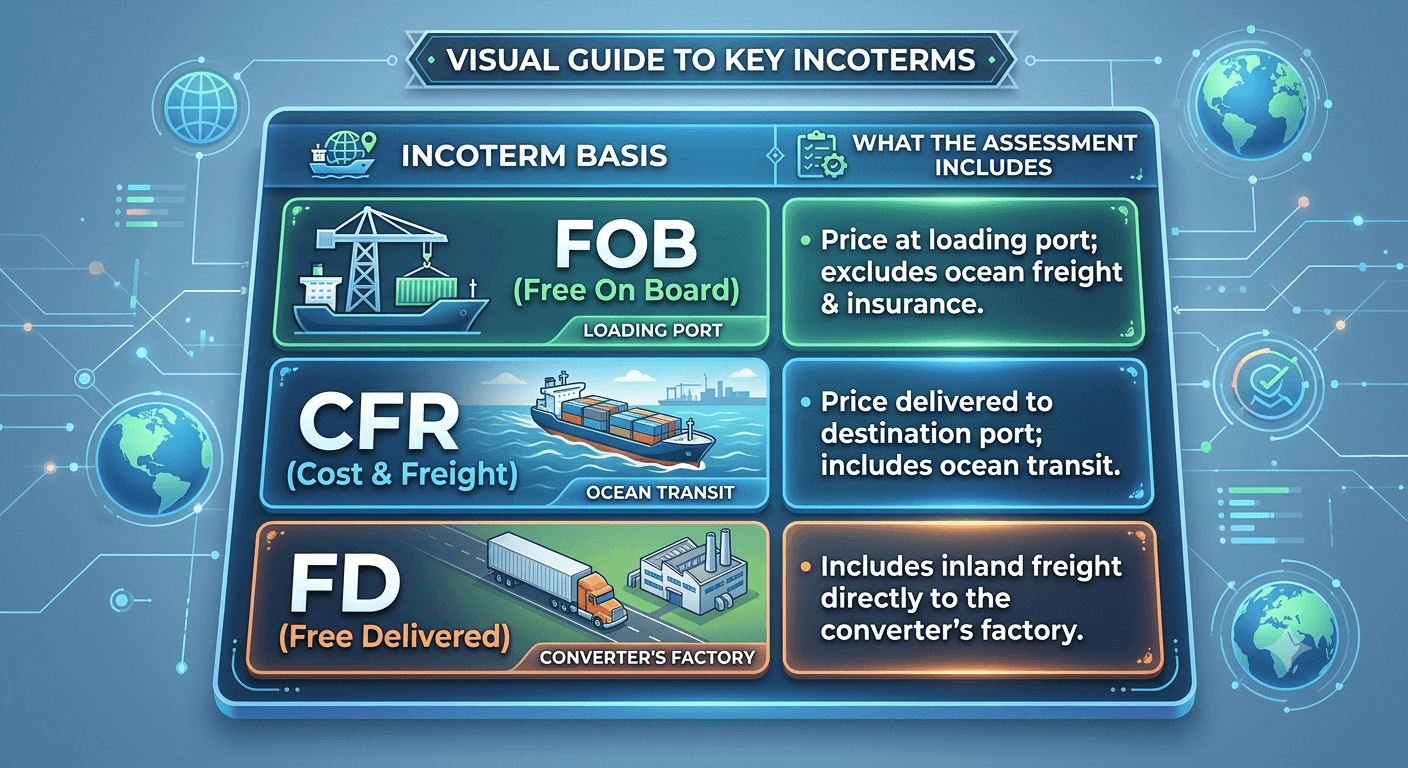
By standardising price revisions across specific Incoterms and regions (e.g., CFR South Asia vs. CFR SE Asia), these reports eliminate ambiguity when comparing global import offers against domestic polymer quotes.
Business Impact for Procurement Leaders
For industrial manufacturers and resin buyers, aligning procurement strategies with ICIS and Platts price revisions delivers clear advantages:
- Margin Protection: Helps converters adjust finished-product prices in line with raw material cost changes.
- Negotiation Leverage: Equips buyers with verified data to counter unverified supplier price hikes.
- Risk Management: Facilitates hedging strategies and accurate budget forecasting.


