
Indian Pipe Tender Market Overview (Apr–Nov 2025): Opportunities, Insights & How Suppliers Can Win
Summary
India’s infrastructure push is translating directly into rising demand for pipes across water supply, irrigation, sewerage, and urban development projects. Between 1st April and 30th November 2025, government departments released 20,881 pipe procurement related tenders worth ₹2,213 crore, making this one of the most active procurement cycles for pipe manufacturers and suppliers in recent years.

India’s infrastructure push is translating directly into rising demand for pipes across water supply, irrigation, sewerage, and urban development projects. Between 1st April and 30th November 2025, government departments released 20,881 pipe procurement-related tenders worth ₹2,213 crore, making this one of the most active procurement cycles for pipe manufacturers and suppliers in recent years.
This report breaks down where these opportunities are coming from, who is winning contracts, and how pipe manufacturers can tap this growing market more effectively.
A ₹2,213 Crore Market Driven by Infrastructure & Utilities
The current pipe tender market is supported by large, multi-year government missions focused on water accessibility, sanitation, irrigation, and urban infrastructure.
Key demand drivers include:
- Rural and urban water supply expansion
- Sewerage and drainage network upgrades
- Irrigation pipeline projects
- Smart city and municipal infrastructure works
As a result, pipe procurement is happening consistently across central ministries, state departments, municipal corporations, and public sector bodies.
Government Schemes Fueling Pipe Demand
Several flagship government schemes are continuously releasing pipe tenders across India:
- Jal Jeevan Mission (JJM) – Rural drinking water supply pipelines
- AMRUT 2.0 – Urban water supply and sewerage infrastructure
- Swachh Bharat Mission – Sanitation and drainage networks
- Pradhan Mantri Krishi Sinchai Yojana (PMKSY) – Irrigation pipelines and water management
- Namami Gange Mission – Sewerage and wastewater infrastructure
Together, these schemes ensure a long-term and recurring demand pipeline for pipe manufacturers across categories.
Where the Opportunities Are: Tender Market Breakdown
Understanding where tenders are being floated is critical for manufacturers planning their government sales strategy.
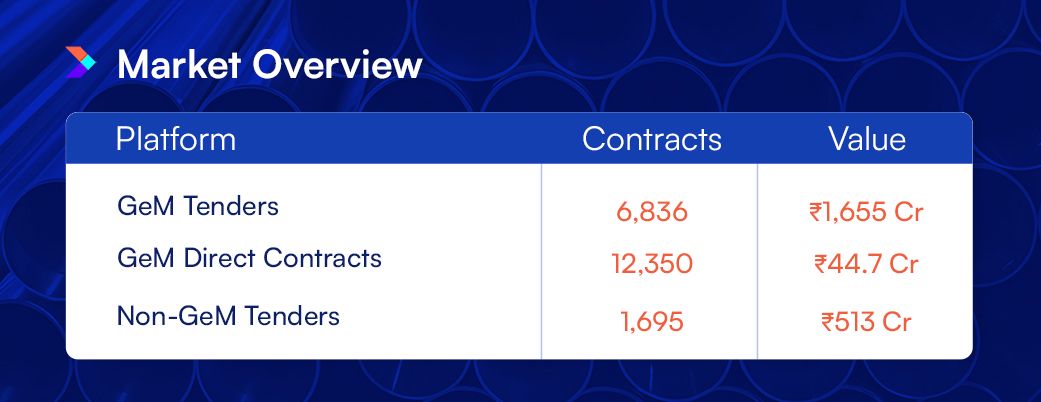
Non-GeM Tenders (Eprocure, IREPS, NProcure and others)
- 1,695 tenders
- ₹513 crore in value
These tenders are released through state procurement portals, PHEDs, irrigation departments, municipal corporations, and infrastructure authorities. They usually involve larger project values, longer execution timelines, and stricter technical eligibility criteria.
GeM Tenders (Bid-Based)
- 6,836 tenders
- ₹1,655 crore in value
GeM continues to be the largest value contributor to the pipe tender market. These tenders typically involve:
- PVC, HDPE/MDPE, DI, GI, and UPVC pipes
- Central and state department procurement for different schemes
For many manufacturers, GeM tenders represent the most scalable route to consistent government business.
GeM Direct Supply Contracts
- 12,350 orders
- ₹44.7 crore in value
While smaller in ticket size, direct contracts are high in volume and often repeat-driven.
They are especially relevant for:
- Regional suppliers
- MSME manufacturers
- Distributors and authorised dealers
These orders help suppliers maintain steady cash flow alongside larger project-based tenders.
Also Check: India’s Paint Supply Market 2025: What the Numbers Reveal
Industry Leaders in GeM Pipe Direct Contracts
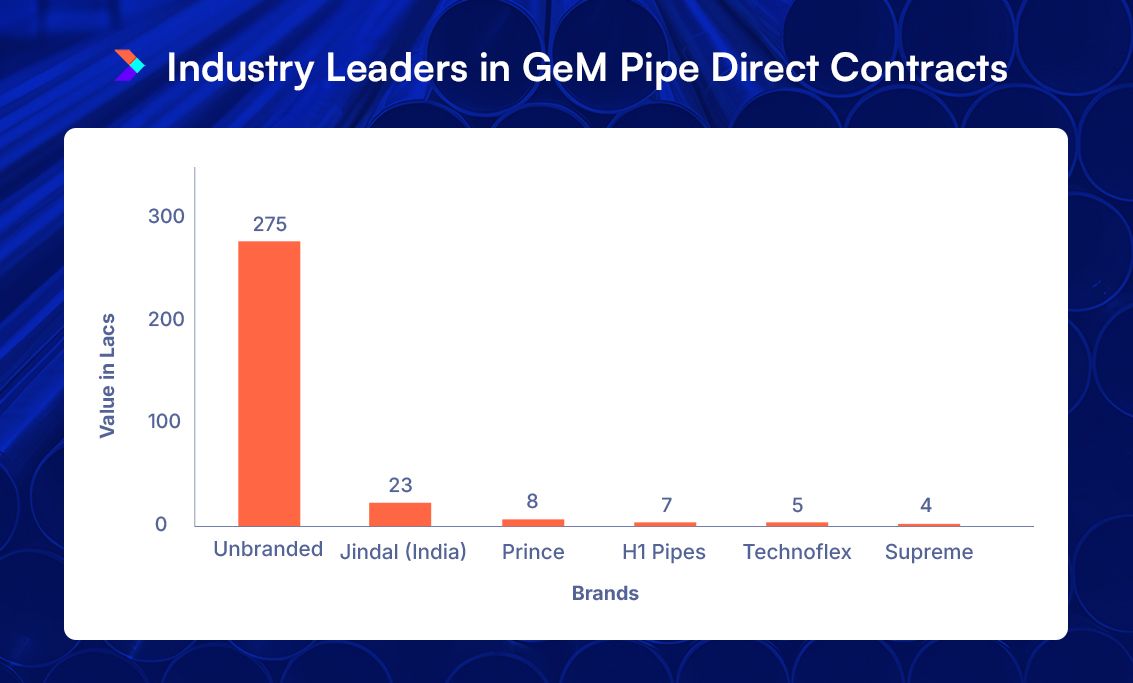
An analysis of GeM direct supply contracts shows that, despite the presence of well-known brands, the market is far from monopolised.
A significant portion of orders falls under the “Unbranded / NA” category as most of the pipe related categories are tagged in Q3 quadrant, giving a clear opportunity for smaller brands to capture market share.
Key Insight
The dominance of the unbranded category indicates that:
- Government buyers are open to new and mid-sized suppliers
- Brand recognition alone does not guarantee wins
- Visibility, eligibility matching, and timely participation play a major role in success
For pipe manufacturers, this signals a clear opportunity to grow government business without competing solely on brand strength.
What This Means for Pipe Manufacturers & Suppliers
The data highlights a few important realities of the Indian pipe tender market:
- Strong demand across PVC, HDPE/MDPE, GI, DI, and UPVC segments
- Continuous tender releases from both GeM and state portals
- Opportunities for large manufacturers as well as regional and MSME suppliers
- A fragmented tender ecosystem where many relevant opportunities are missed, not lost
Most manufacturers miss tenders simply because they are scattered across multiple portals and departments.
How Nexizo Helps Pipe Manufacturers Tap This Market
Winning government tenders today is less about volume bidding and more about precision and intelligence.
Nexizo helps pipe manufacturers and suppliers by:
✔ Discovering every relevant tender from GeM and 900+ state and central portals in one platform.
✔ Filtering by exact product line from a wide range of PVC, HDPE, MDPE, DI, GI, UPVC, sewer pipes, irrigation pipes, fittings, and more.
✔ Providing competitor intelligence to help you track:
- Who is winning pipe tenders
- Which brands dominate specific states or departments
- Historical award data and trends
✔ Smart tender shortlisting by providing pipe specifications (Dia & Class), approved brands, quantity and other details upfront
✔ Real-time alerts for newly released tenders, closing deadlines, market movements and price trends
Conclusion: A Market Too Big to Ignore
With ₹2,213 crore worth of pipe tenders released in just eight months, the Indian government procurement market presents a clear growth opportunity for pipe manufacturers and suppliers.
The demand is strong, the buyers are active, and the entry barriers are lower than many assume. The real challenge lies in finding the right tenders at the right time.
That’s where AI-powered data-driven platforms like Nexizo help manufacturers move from reactive bidding to a planned, scalable tender strategy.

India’s Paint Supply Market 2025: What the Numbers Reveal

Understanding CPWD Enlistment Rules 2026: Eligibility, Tendering Limits & Renewal Process
